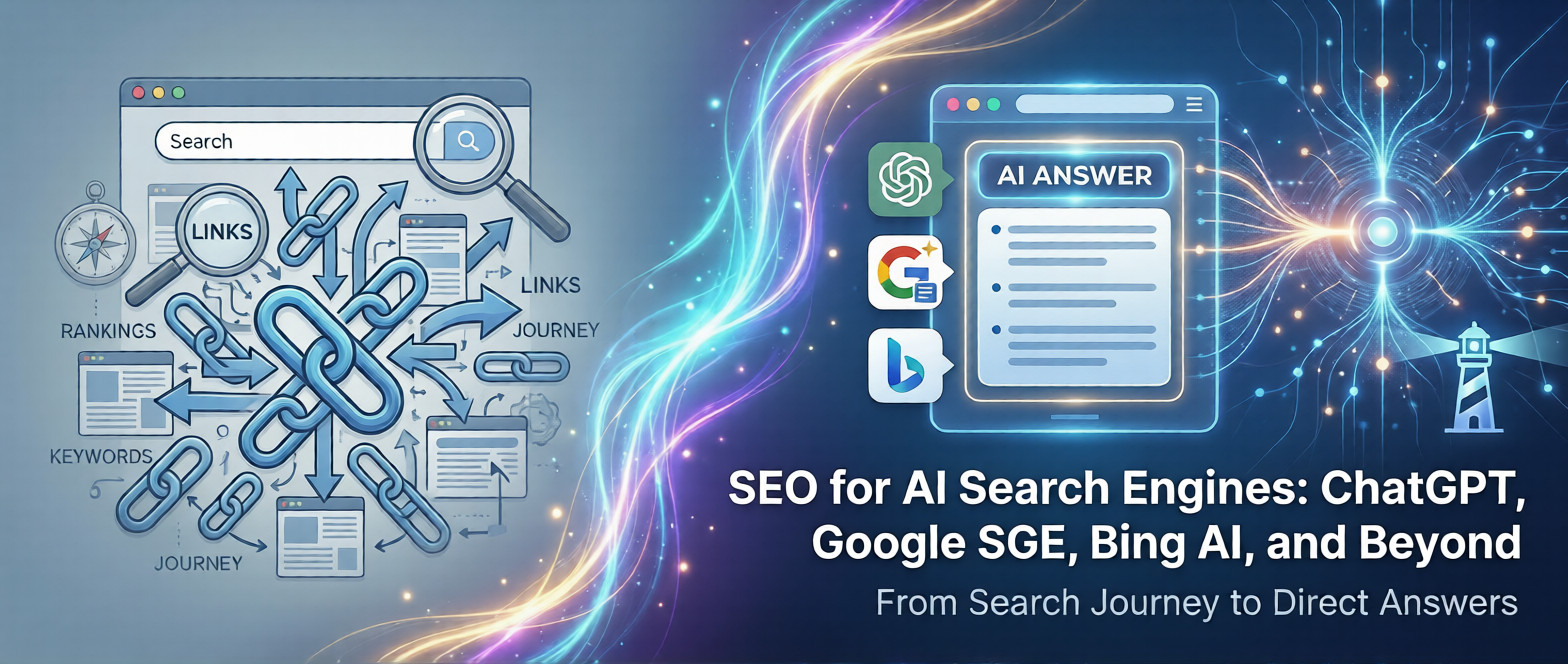
For years, finding information online was a journey. You opened Google, typed a question, scrolled through links, clicked a few sites, compared what you found, and finally decided what to trust.
That flow shaped how we used the internet - and how SEO worked.
Today, something fundamental has changed. Ask "which insurance plan fits my situation?", "how do I improve website performance?" or "is green tea a bad idea before bed?" and you are increasingly given a single, composed answer before you scroll at all.
SEO is no longer about being one link among ten. It is about becoming the explanation the answer is built from.
What answer engines actually changed
Traditional search engines focused on finding pages. Answer engines focus on resolving questions.
Instead of "here are some links, you figure it out", the response is "here is the answer, already assembled". The platforms driving this shift today are ChatGPT with conversational explanations, Google's AI overviews in SGE, and Bing's answers with inline citations. None of them scan for keyword frequency. They evaluate meaning, intent and context.
Why classic SEO alone stopped being enough
The traditional playbook optimised for keyword placement, backlinks, meta tags and ranking position. Answer engines do not think in rankings. They evaluate content against questions like:
- Does this actually answer the question that was asked?
- Would a beginner understand it without extra help?
- Does it read as trustworthy and balanced, or as promotional?
Content that is confusing, shallow, or written purely to satisfy an algorithm gets skipped - not penalised, just quietly passed over.
Classic SEO has not become worthless. Crawlability, structured data, page speed and clean URLs still determine whether your content can be read at all. What has changed is that they are now the entry fee, not the strategy.
How an answer engine picks what to use
1. Intent matters more than keywords
The system optimises for what the reader wanted to know, not the exact phrase they typed.
For "is green tea good at night?", it looks for content that explains caffeine content, the effect on sleep onset, the best time of day to drink it, and reasonable alternatives - not a page repeating "green tea night benefits" eleven times.
2. Clarity beats authority
A small, clearly written blog can outperform a large brand when the explanation is simpler, the structure is better and the tone sounds like a person. "Let me explain this clearly" wins over "let me sound authoritative".
3. Structure speeds up comprehension
Descriptive headings, short paragraphs, lists where lists belong, and a logical progression from question to answer. The rule of thumb is reliable: if a human can skim it easily, a machine can parse it accurately.
4. Depth without filler builds trust
Thin articles, generic advice and rephrased definitions get ignored. Content that explains why something works, when it does not, and what the real trade-offs are signals genuine understanding - which is exactly what a citation-seeking system is looking for.
Optimising for each platform
ChatGPT and conversational assistants
These do not rank websites. They learn from patterns across high-quality writing, and increasingly retrieve live sources for current questions. To improve your odds:
- Write evergreen, educational content rather than news-cycle filler
- Explain concepts from first principles, not from jargon
- Avoid clickbait framing - it reads as unreliable
- Keep the tone neutral and specific
The test: if an assistant had to explain this topic to a beginner, would my article make that job easier?
Google SGE and AI overviews
SGE composes a summary above the traditional results, drawing from pages it can parse quickly.
- Answer the primary question within the first 20% of the page
- Use plain-language definitions before technical ones
- Break processes into numbered steps
- Cut the long, atmospheric introduction
Write sections that stand alone as complete answers. A section that only makes sense after reading the previous four is a section that will never be quoted.
Bing AI and cited answers
Bing surfaces citations under its responses, which makes verifiability the deciding factor. Be factual and balanced, avoid absolute claims you cannot support, update content when the facts change, and use terminology consistently across the page.
The new formula
| Old signal | What replaced it | Why |
|---|---|---|
| Keyword density | Question coverage | Systems match meaning, not repetition |
| Ranking position | Citation-worthiness | There is often only one answer shown |
| Backlink volume | Demonstrated expertise | Depth is easier to verify than popularity |
| Long dwell time | Fast comprehension | A clear answer is a good answer |
| Page count | Page quality | Thin content dilutes the whole domain |
Clarity × Helpfulness × Trust = visibility in an answer engine.
A checklist before you publish
Does this answer a question a real person would actually type?
Is the core answer visible in the first 20% of the page?
Could a non-specialist follow it without looking anything up?
Does it explain why, not only what?
Does it read as honest and calm rather than promotional?
Is the technical foundation solid - crawlable, fast, structured data present?
The technical floor still matters
None of the above helps if your content cannot be reached or parsed. The unglamorous fundamentals remain mandatory:
- Clean, stable URLs - descriptive slugs that do not change
- Structured data -
Article,FAQPage,HowToandBreadcrumbListschemas give machines an unambiguous reading of your page - Semantic HTML - a real heading hierarchy, not styled
divs - Performance - Core Web Vitals still gate crawl efficiency and user trust
- A current sitemap and sane robots rules - so nothing important is invisible
SEO becomes answer engineering
The job is no longer chasing rankings. It is designing the best possible answer to a question you genuinely understand.
The winners in this shift are educators, clear thinkers, specialists and honest creators - not content factories. Answer engines are not killing SEO. They are removing noise and amplifying value, rewarding content that respects the reader, explains rather than impresses, and builds understanding instead of traffic alone.
If you focus on helping people genuinely understand something, the machines will help people find you.