Frontend technical debt rarely announces itself. There are no failed pipelines, no red dashboards, no critical alerts telling you something is wrong.
On the surface everything looks healthy. The application loads reliably, interactions behave as expected, releases keep shipping on schedule. From the outside the system looks stable - successful, even.
But inside the codebase, something has quietly shifted.
A UI change that used to take thirty minutes now takes half a day. Engineers hesitate before opening certain components - not because they are complex, but because they are unpredictable. Pull requests grow larger and more defensive, padded with extra checks and duplicated logic "just in case". Bug fixes stop feeling routine and start feeling risky.
Nothing is technically broken - yet everything feels heavier.
This is the silent phase of frontend technical debt: the stage where the product still works, but the system has begun to resist change. Progress slows not because features got harder, but because the codebase no longer offers confidence.
And in frontend engineering, that resistance is dangerous. Frontend systems do not fail when buttons stop working. They fail when small changes become stressful, refactors feel unsafe, and teams start optimising for avoidance instead of improvement.
More than any other layer in the stack, frontend systems live and die by how easily they can change.
What frontend technical debt really is
Frontend technical debt is the accumulation of decisions that optimised for speed today at the cost of clarity tomorrow.
It is not about mistakes. It is about trade-offs that were never revisited. In frontend codebases, that debt tends to live in:
- Components that grew without boundaries
- Styles that lost their source of truth
- State that no longer has a clear owner
- UI logic scattered across unrelated layers
- Assumptions that stopped being true months ago
Every one of these started as a reasonable decision. That is exactly what makes them hard to see.
How it sneaks in - eight patterns with examples
1. "Temporary" UI logic that becomes permanent
Added quickly for a release:
{isAdmin ? (
  <AdminDashboard />
) : isBetaUser ? (
  <BetaDashboard />
) : user?.role === "manager" ? (
  <ManagerDashboard />
) : (
  <DefaultDashboard />
)}
Six months later nobody remembers the precedence rules, new roles keep getting appended to the chain, and no test covers every branch.
Fragile conditional logic, fear of removing any branch, and no domain model anyone can point at.
Centralise the role-to-dashboard mapping. Encode intent, not conditions.
const dashboardByRole = {
  admin: AdminDashboard,
  manager: ManagerDashboard,
  beta: BetaDashboard,
  default: DefaultDashboard,
};

const Dashboard = dashboardByRole[user.role] ?? dashboardByRole.default;
2. Component duplication disguised as pragmatism
UserCard.jsx
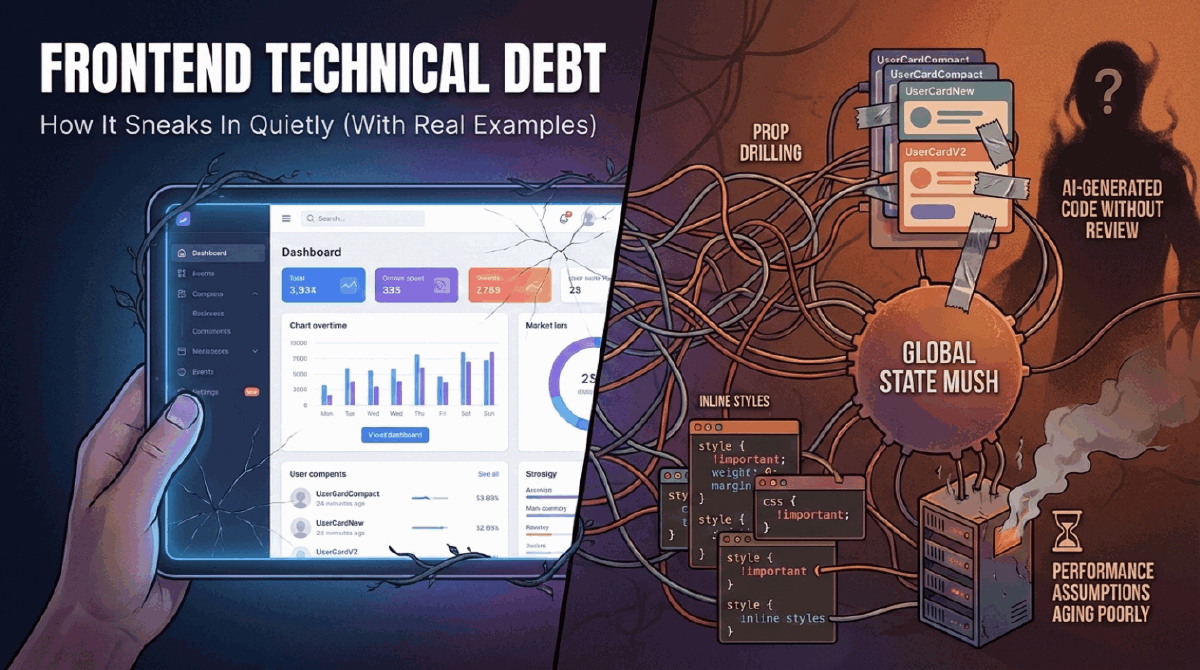
UserCardCompact.jsx
UserCardNew.jsx
UserCardV2.jsx
Each one exists because "changing the original might break something".
Visual inconsistency, bugs fixed in one copy but not the others, and a design system quietly eroding.
One component, several variants. Composition over cloning.
<UserCard variant="compact" />
<UserCard variant="detailed" />
3. Styling debt that starts small and grows wild
.card { padding: 16px; }
.card.special { padding: 18px !important; }
.card.special.mobile { padding: 14px !important; }
Then someone reaches for an inline style, because at that point it is the only thing that reliably wins:
<div style={{ padding: "20px" }} />Layouts break on trivial changes, spacing becomes unpredictable, and nobody wants to touch the stylesheet.
Design tokens, one spacing scale, and a single styling strategy the whole team agrees on.
:root {
  --space-sm: 8px;
  --space-md: 16px;
  --space-lg: 24px;
}
4. Prop drilling that turns components into tunnels
<App>
  <Layout user={user}>
    <Sidebar user={user}>
      <Menu user={user}>
        <MenuItem user={user} />
      </Menu>
    </Sidebar>
  </Layout>
</App>
The UI works. State ownership does not exist.
Tight coupling, updates that are hard to reason about, and refactors that feel dangerous.
Lift state deliberately, use context or a store where it genuinely belongs, and define ownership explicitly.
5. State that lives wherever it was convenient
Loading state in component A. Error state in component B. The fetch itself in component C.
No coherent mental model, race conditions, and re-renders nobody can explain.
Think in state domains, not components.
Who owns this data?
Who is allowed to mutate it?
Who only consumes it?
6. Performance assumptions that age poorly
items.map(item => <ExpensiveCard key={item.id} data={item} />)This was fine with twenty items. There are now two thousand.
Janky scrolling, frozen interactions, and reactive "performance fixes" written under pressure.
Virtualisation, memoisation applied with intent, and measurement before optimisation - while still designing for growth.
7. Accessibility debt that ships every sprint
<div onClick={handleClick}>Submit</div>It works visually. It fails silently for everyone who is not using a mouse.
<button type="button" onClick={handleClick}>Submit</button>Keyboard users get blocked, screen readers get confused, and every month you wait makes the retrofit more expensive.
8. Generated code merged without review
Modern tooling can produce a lot of code very quickly. Merged without scrutiny, it shows up as different patterns in every file, inconsistent naming, and logic that was copied rather than understood.
No shared mental model, debugging by guesswork, and a codebase that feels foreign to the team that owns it.
Treat generation as a boilerplate remover and an idea generator - never as an architecture decider or a substitute for review.
The behavioural signs
The earliest indicators of frontend debt are not technical. They are things people say:
- "Let's not touch that file."
- "It breaks sometimes."
- "Just copy what already works."
- "We'll clean this up later."
When fear enters development, debt is already present. The metrics catch up later.
How healthy teams prevent it
Design for change
Assume requirements will evolve, designs will change and scale will increase. Every one of those is a certainty, not a risk.
Optimise for readability over cleverness
The best frontend code is boring, predictable and obvious. Cleverness is a loan against your team's future attention.
Treat UI code as infrastructure
The interface is not decoration. It is user-facing infrastructure, and it deserves the same rigour you would apply to a service.
Make consistency non-negotiable
Consistency reduces bugs, cognitive load and onboarding time simultaneously. Very few decisions pay off in three directions at once.
The one question that prevents most of it
If someone else changes this in six months, will they feel confident or afraid?
That question is more powerful than any lint rule, because it is the only one that measures the thing that actually matters.
The true cost
Frontend technical debt does not kill products overnight. It kills momentum, confidence and the enjoyment of building. It turns creative problem-solving into defensive coding, and replaces curiosity with caution.
The strongest frontend systems are not the ones built fastest. They are the ones that stay calm, predictable and adaptable under pressure - because in frontend engineering, ease of change is the ultimate feature.
Every decision you make today is either buying that future, or quietly borrowing against it.