Intelligent features are everywhere right now - demos, tools, job descriptions, product roadmaps. For frontend developers with a React and UI-first background, that creates confusion, pressure and sometimes unnecessary fear.
Let us reset the conversation. This is not about becoming a machine learning engineer. It is about understanding how this technology actually intersects with frontend work - practically, calmly and usefully.
Myth: frontend developers must learn machine learning
Start by removing the biggest misconception. You do not need to train neural networks, learn advanced statistics, build models from scratch or read research papers every week.
What you need is literacy, not specialisation. Think of it the way you think about browsers or cloud services: you do not build Chrome, but you understand how Chrome behaves, performs and fails. This is becoming a platform capability, not a replacement for frontend skill.
It is a capability layer, not a feature
The common mistake teams make is saying "let's add intelligence to this screen". That is the wrong framing. The better question:
Where does intelligence reduce friction for the user?
Where it genuinely fits in an interface:
- Smart defaults instead of an empty form
- Predictive suggestions instead of manual typing
- Context-aware hints exactly where someone hesitates
- Natural language input instead of a rigid field structure
It should feel invisible and helpful, not flashy and bolted on.
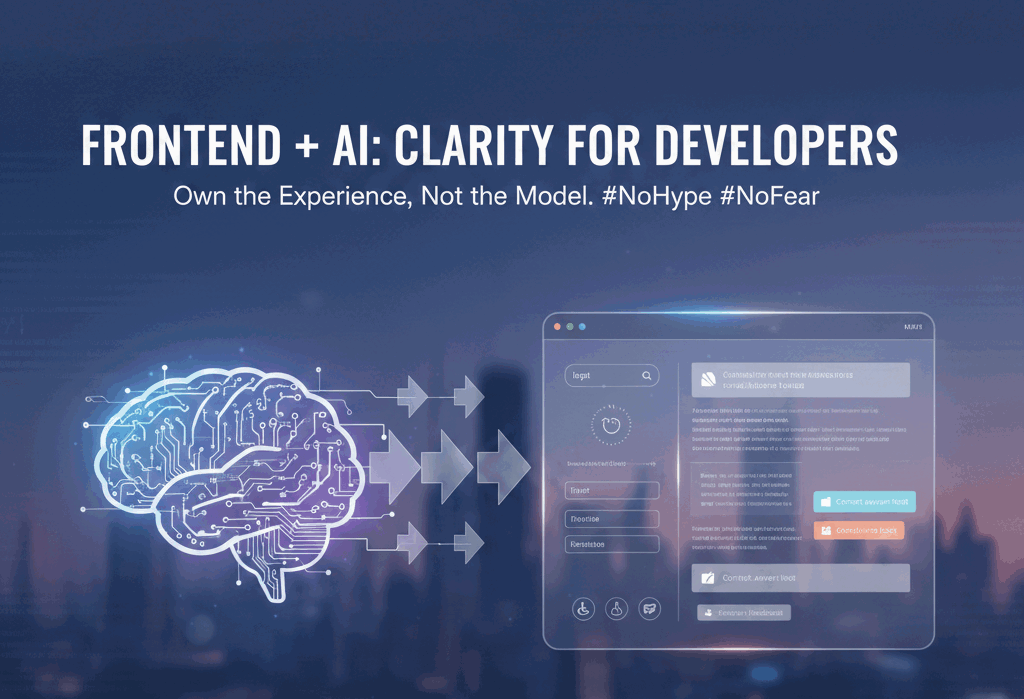
Frontend developers own the experience
This is the critical part. The model output is not the product. The interface around it is the product.
As the frontend developer, you decide how responses are displayed, how the "thinking" state feels, how uncertainty or low confidence is communicated, and how users correct, retry or refine what they got back.
What does "working on it" actually look like - a spinner, a skeleton, streamed text?
Do we stream the response or wait for the whole thing?
How do we present a bad or partial output without breaking trust?
How does someone undo or retry safely?
Every one of those is a UX and UI problem. None of them is a modelling problem. They sit squarely in frontend territory.
Prompt construction is input design
Prompts are inputs with unusually high impact. Frontend developers already design forms, search boxes, filters and validation rules - this is the next evolution of the same skill.
In practice that means structuring user input before it is sent, adding system-level instructions as guardrails, splitting large instructions into reusable parts, and preventing vague or unsafe input from ever leaving the client.
In most products, users never see the prompt. You generate it for them from their UI choices. That makes prompt construction a design responsibility, not just a technical one.
It changes state management - significantly
Traditional frontend logic is a straight line:
Input → Predictable outputThis is not:
Input → Probabilistic output → User feedback → IterationWhich introduces genuinely new UI problems: non-deterministic results, variable and sometimes long latency, multiple versions of the same output, and a real need for undo, retry and history.
Frontend developers now have to design recoverable interfaces, not just happy paths.
Performance matters more, not less
These APIs are slower than local logic, network dependent and occasionally unpredictable. That makes frontend craft more important. The patterns you will lean on:
- Skeleton loaders that communicate structure, not just activity
- Streamed responses so perceived latency drops
- Optimistic UI where the operation is reversible
- Progressive disclosure of results as they arrive
Intelligence does not excuse poor UX. If anything, it exposes it faster.
Accessibility is non-negotiable
Generated content still has to be screen-reader friendly, keyboard accessible, semantically structured and visually predictable. Which means you need to sanitise and normalise output, avoid dumping raw markdown into the DOM, and make sure dynamic updates are announced properly with live regions.
Accessibility debt accumulates faster when content is generated, because nobody wrote the markup by hand and nobody checked what the DOM actually looks like after it renders.
It will not replace frontend developers - but it will expose weak ones
It can generate boilerplate components, CSS, utility functions and documentation very well. It cannot understand product context, balance long-term trade-offs, design a system that scales, or own user trust.
The frontend developer who thrives writes less boilerplate, thinks more systemically, designs intentional flows, and owns the interaction end to end.
What to understand, not master
- API request and response patterns
- Streaming versus non-streaming interfaces
- Error handling and graceful fallbacks
- Content moderation basics
- Cost per request - because someone is paying for every retry
This will soon be as fundamental as understanding REST.
The real shift: from screen builder to flow designer
Frontend development is moving from "how do I build this screen?" to "how does a user move through this safely and confidently?"
That is a higher-impact role, and frontend developers are better positioned for it than almost anyone else in the stack - because it is fundamentally a question about interfaces, not about models.
Final thought
The developers who thrive will be the ones who stay calm amid the hype, learn selectively, design intentionally, and own the experience rather than the model.
The model is just a tool. The interface is still the product.