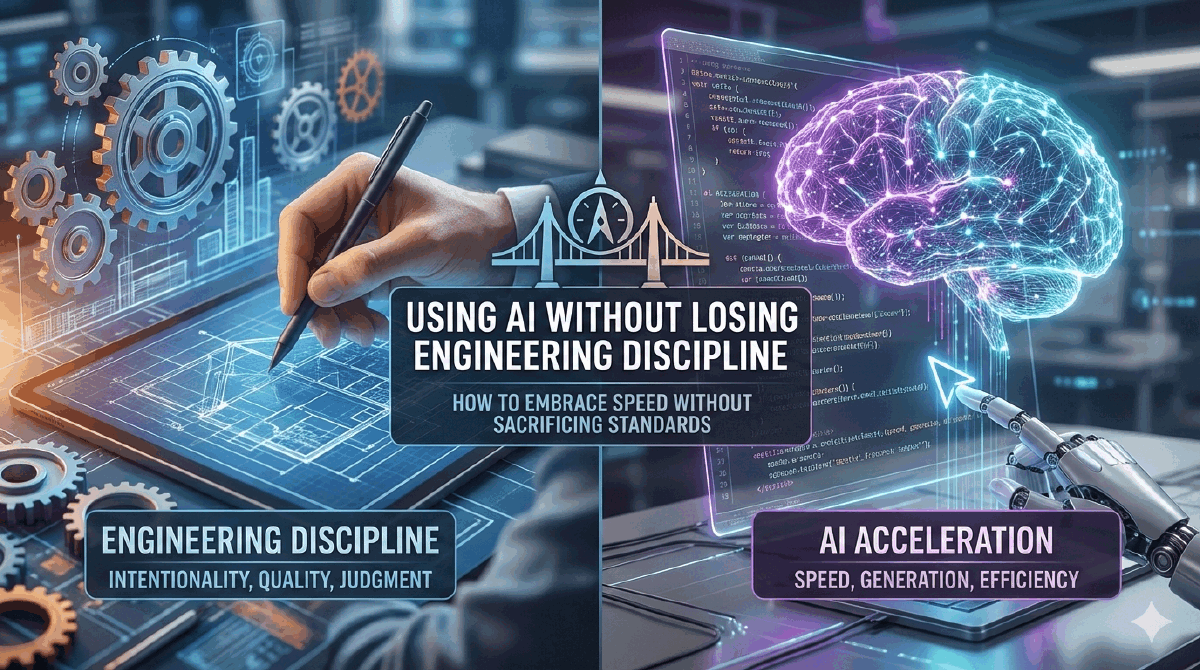
Modern tooling is the fastest productivity multiplier engineering has ever seen. Need a function? Generated. Need a refactor? Suggested. Need an explanation of an unfamiliar module? Delivered in seconds.
For developers on fast-moving teams this feels like a superpower, and the temptation is obvious: move faster, ship sooner, write less.
But there is an uncomfortable truth underneath it.
Speed without discipline does not scale. It accumulates.
Generative tooling does not replace engineering discipline - it tests it. The real question today is not whether to use it. It is how to use it without eroding the fundamentals that make software reliable, maintainable and trustworthy.
What engineering discipline actually means
Discipline is not about rejecting tools or writing verbose code. It is about intentionality. In practice it shows up as:
- Framing the problem clearly before writing code
- Choosing predictable architectures over clever ones
- Preferring readability to brevity
- Writing tests that validate behaviour, not coverage percentages
- Making decisions that consider future maintainers, not just current velocity
These principles existed long before any of the current tooling, and they matter more now, not less.
The tool is not the problem - blind trust is
Generation does not break discipline on its own. Uncritical usage does. The failure patterns are already visible on real teams:
Pasting output without understanding what it does
Accepting "it works" without checking the edge cases
Letting a suggestion define architecture instead of constraints defining it
Using generation as a substitute for thinking rather than an amplifier of it
These tools are confident even when they are subtly wrong. Discipline is the thing that questions that confidence.
The right mental model: a very fast junior engineer
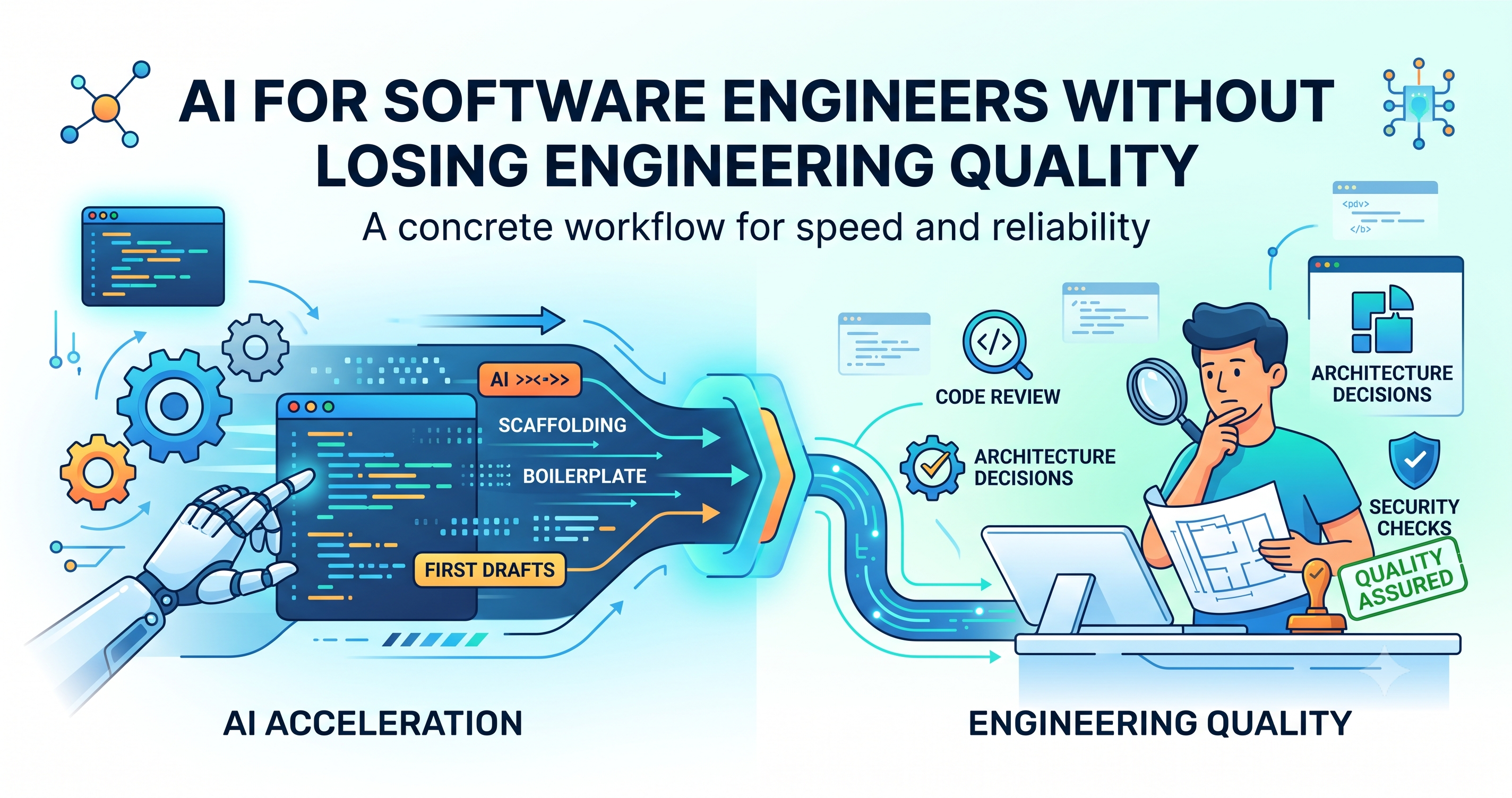
Treat generated output the way you would treat work from a capable, enthusiastic junior - helpful, quick, and not authoritative.
You would not merge a junior's pull request unreviewed. You would not accept their architecture decisions without discussion. You would not let them skip testing because it "seemed fine". The same standard applies here:
Propose · generate · accelerate
Decide · verify · remain accountable
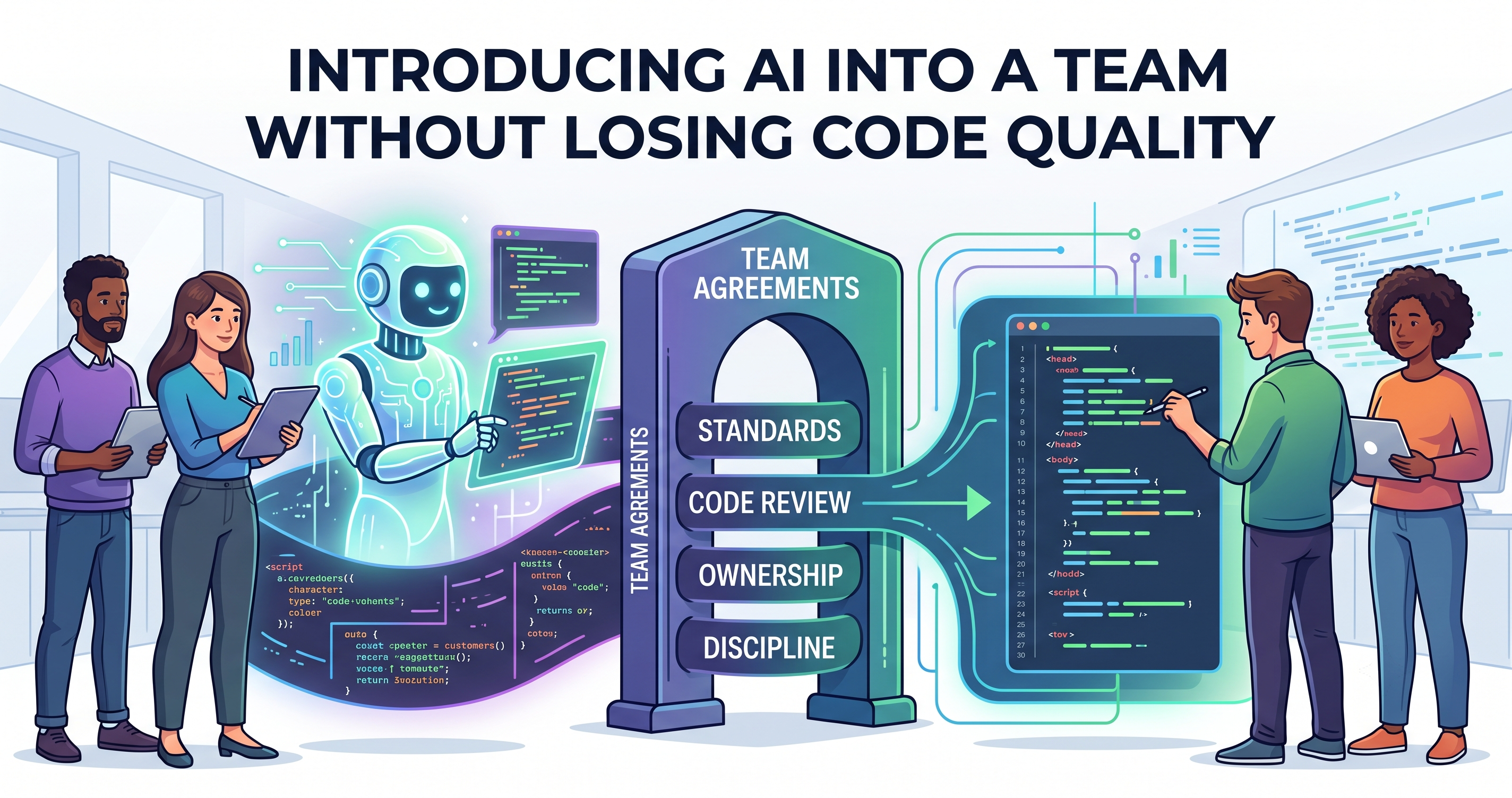
Ownership never transfers. Whatever ships with your name on the commit is yours.
Where the leverage genuinely is
Removing mechanical work
Boilerplate, repetitive patterns and scaffolding are where this tooling earns its keep. Every minute not spent on structural typing is a minute available for an actual engineering decision.
Improving code quality - with review
Clearer naming, duplicated logic spotted, edge cases surfaced. Useful as a second set of eyes. Dangerous as a final judge.
Compressing knowledge
Summarising an unfamiliar codebase, explaining legacy logic, translating a concept across stacks. It shortens the learning curve. It does not shorten the thinking.
Where discipline has to lead
Architecture and system design
These tools lack your business context, your team's constraints and your long-term trade-offs. Discipline means choosing boring, proven designs when boring is the right answer - which is most of the time.
Security and performance
Generated code can miss vulnerabilities entirely or optimise something that was never the bottleneck. Discipline demands skepticism, benchmarks and real review.
Testing and validation
A generated test suite will happily assert that your code does what your code does. Good engineers test business invariants, failure modes and how the system behaves when a dependency is slow or absent.
The hidden risk: skill atrophy
Over-reliance erodes fundamentals quietly. If you always outsource debugging, design and decisions, pattern recognition weakens and engineering intuition fades.
Struggle is not inefficiency. It is how expertise forms.
The developers who will be strongest in five years are the ones who still occasionally do it the hard way on purpose.
A disciplined workflow
Understand the problem first. Never open a prompt as a substitute for understanding.
Use the tool to explore options. Breadth is where it excels.
Make the decision yourself. With reasons you could defend in a review.
Review the output like production code. Because that is what it is about to become.
Test intentionally. Against behaviour and failure modes, not line coverage.
Refactor manually. That is where you rebuild the mental model.
The tooling speeds up individual steps. It never replaces the loop.
Discipline is the differentiator
In a world where everyone has the same tools, speed becomes common and output becomes cheap. What stays rare is judgment, taste, responsibility and long-term thinking.
That is engineering discipline, and it is the thing that will still be scarce when the tools are ubiquitous.
Final thought
The future is not tooling versus engineers. It is engineers who think versus engineers who outsource thinking.
Use the tools aggressively - but deliberately. Let them handle repetition, never responsibility. The quality of software will always reflect the quality of the engineer behind it.