Using AI Without Losing Engineering Discipline
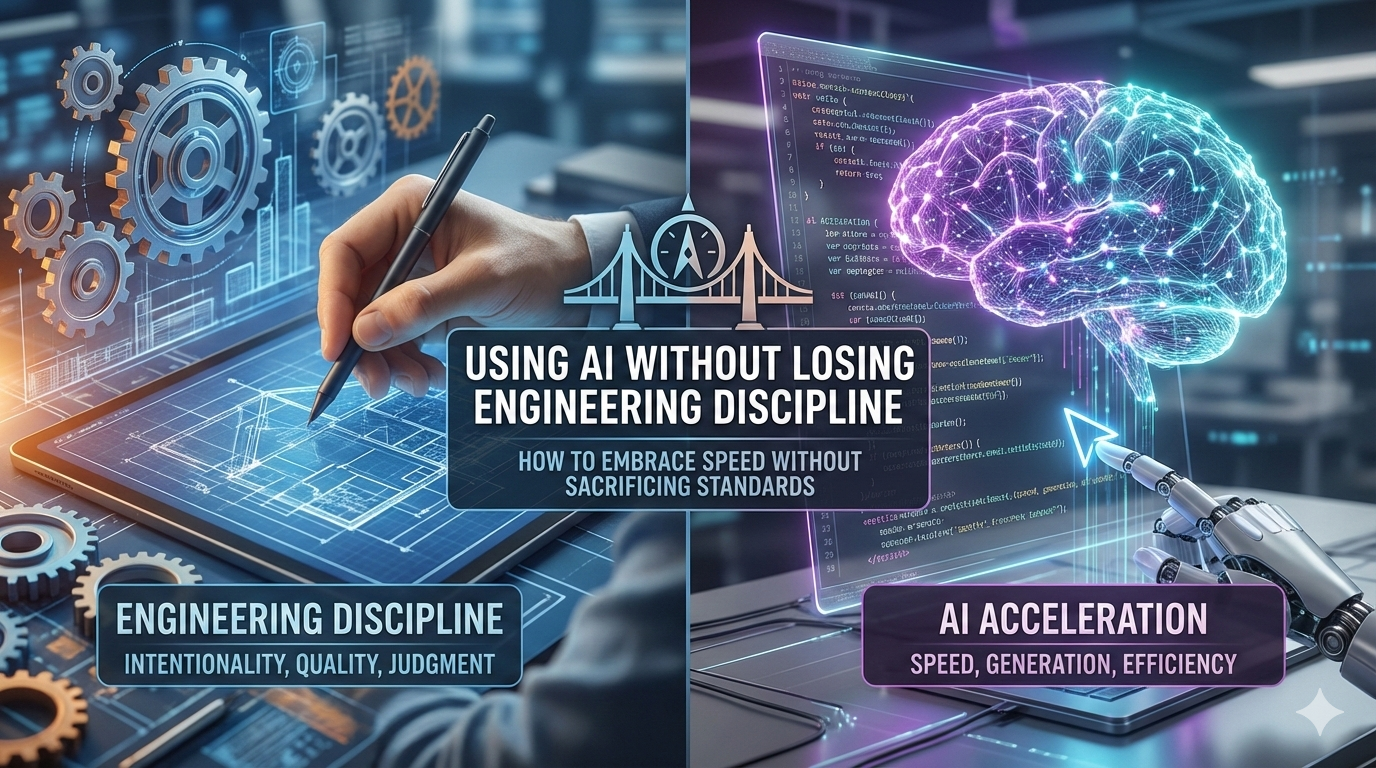
AI is the fastest productivity multiplier engineering has ever seen.
Need a function? Generated. Need a refactor? Suggested. Need a solution? Explained in seconds.
For developers, especially in fast-moving teams, this feels like a superpower. The temptation is obvious: move faster, ship sooner, write less.
But here’s the uncomfortable truth:
Speed without discipline doesn’t scale. It accumulates debt.
AI doesn’t replace engineering discipline - it tests it.
The real challenge today isn’t whether to use AI. It’s how to use AI without eroding the fundamentals that make software reliable, maintainable, and trustworthy.
🧱 What Engineering Discipline Really Means
Engineering discipline isn’t about rejecting tools or writing verbose code. It’s about intentionality.
Discipline shows up as:
- Clear problem framing before writing code
- Predictable architectures over clever hacks
- Readability over brevity
- Tests that validate behavior, not just coverage
- Decisions that consider future maintainers, not just current velocity
These principles existed long before AI - and they matter even more now.
⚠️ AI Isn’t the Problem - Blind Trust Is
AI doesn’t break discipline on its own. Uncritical usage does.
Common failure patterns we’re already seeing:
- Copy-pasting AI output without understanding it
- Accepting “working” code without verifying edge cases
- Letting AI define architecture instead of constraints
- Using AI as a replacement for thinking instead of an amplifier
AI is incredibly confident - even when it’s subtly wrong. Engineering discipline is what questions that confidence.
🧠 The Right Mental Model: AI as a Junior Engineer
Treat AI like a fast junior engineer - helpful, enthusiastic, but not authoritative.
You wouldn’t merge a junior engineer’s PR without review. You wouldn’t accept their architecture decisions without discussion. You wouldn’t let them bypass testing because “it seems fine.”
AI deserves the same treatment:
- It proposes → You decide
- It generates → You verify
- It accelerates → You stay accountable
Ownership never transfers.
✨ Where AI Shines (With Discipline)
1️⃣ Reducing Mechanical Work
Boilerplate code, repetitive patterns, and scaffolding are where AI excels - freeing mental space for real engineering decisions.
2️⃣ Improving Code Quality (With Review)
AI can suggest clearer naming, identify duplicated logic, and highlight edge cases - but it should act as a second set of eyes, not the final judge.
3️⃣ Knowledge Compression
Summarizing unfamiliar codebases, explaining legacy logic, and translating concepts across stacks - AI shortens learning curves, not thinking.
🛡️ Where Discipline Must Lead
Architecture & System Design
AI lacks business context, team constraints, and long-term tradeoffs. Discipline means choosing boring, proven designs when they’re appropriate.
Security & Performance
AI-generated code may miss vulnerabilities or optimize the wrong thing. Discipline demands skepticism, benchmarks, and reviews.
Testing & Validation
AI can write tests - but good engineers test business invariants, failure modes, and real user behavior.
🧠 The Hidden Risk: Skill Atrophy
Over-reliance on AI quietly erodes fundamentals.
If you always ask AI to debug, design, and decide, pattern recognition weakens and engineering intuition fades.
Struggle isn’t inefficiency. It’s how expertise forms.
⚙️ A Disciplined AI Workflow
- Understand the problem first
- Use AI to explore options
- Make the decision yourself
- Review AI output like production code
- Test intentionally
- Refactor manually
AI speeds up steps - but never replaces the loop.
🔑 Discipline Is the Differentiator
In a world where everyone has AI, speed becomes common and output becomes cheap.
What remains rare is judgment, taste, responsibility, and long-term thinking.
That’s engineering discipline.
🧭 Final Thought
The future isn’t AI vs Engineers.
It’s engineers who think vs engineers who outsource thinking.
Use AI aggressively - but deliberately. Let it handle repetition, not responsibility.
The quality of software will always reflect the quality of the engineer behind it.